


How to Use Fine Fragrance Oils in Home and Personal Care Lines
Turn premium scents into profitable candles, perfumes, and everyday bath and body products
As you explore our Fine Fragrance Collection, you may wonder where these exquisite scents could fit into your business. Because they feature complex layers of top, middle, and base notes found in fine perfumery, many have assumed these fragrance oils are only for body care products and perfumes.
In this guide, we bust that myth, break down what fragrance oil prices mean for your per-unit cost of goods, and explore three possible ways to include Fine Fragrance Collection oils into your line—whether you typically focus on candles and home fragrance products or want to expand into the personal care category!
YES!
These fragrances are fully compatible and performance-tested for home fragrance applications.
That means you can use them to craft stunning candles with the same appealing cold throw, room-filling hot throw, and outstanding burn quality you enjoy from our other fragrance oils—but with even more refined scent options.
Unpacking Fragrance Costs
All supply costs used in this article and in the cost & profit details linked below are based on October 2026 prices.
At just shy of $53 per 16 oz. bottle, Fine Fragrance oils do carry a higher price tag than the vast majority of our fragrance oils. This is because they’re formulated with more costly raw ingredients and aromatic components. In comparison, our other 16 oz. fragrances currently average around $33.
When managing your cost of goods (COGs) and profits—especially if you wholesale—every penny counts. For some businesses, sticking to more moderately priced, standard fragrance oils is the most practical choice.
However, when you break down unit costs, the per-product price difference is far smaller than the upfront bottle price suggests.
The best way to see this is to compare two 8.5 oz. net weight candles where the only difference is the fragrance oil cost.
In the following example, Candle 1 uses a "standard" fragrance oil that costs $33 for 16 oz., and Candle 2 uses a Fine Fragrance oil that costs $53 for 16 oz.
Because labor and other overhead costs vary widely, we didn’t include them in these simplified examples throughout this article.
However, always factor these expenses into your final COGs calculations. That gives you the most accurate total cost so you can determine a product's true profitability.
Cost & Profit Comparison: 8.5 oz Studio Tumbler Jar Candles
Let's look at two 8.5 oz Studio Tumbler Jar candles. Candle 1 uses a standard fragrance oil that costs $33 per pound. Candle 2 is identical to Candle 1 except that it was made with a Fine Fragrance oil that costs $53 per pound.
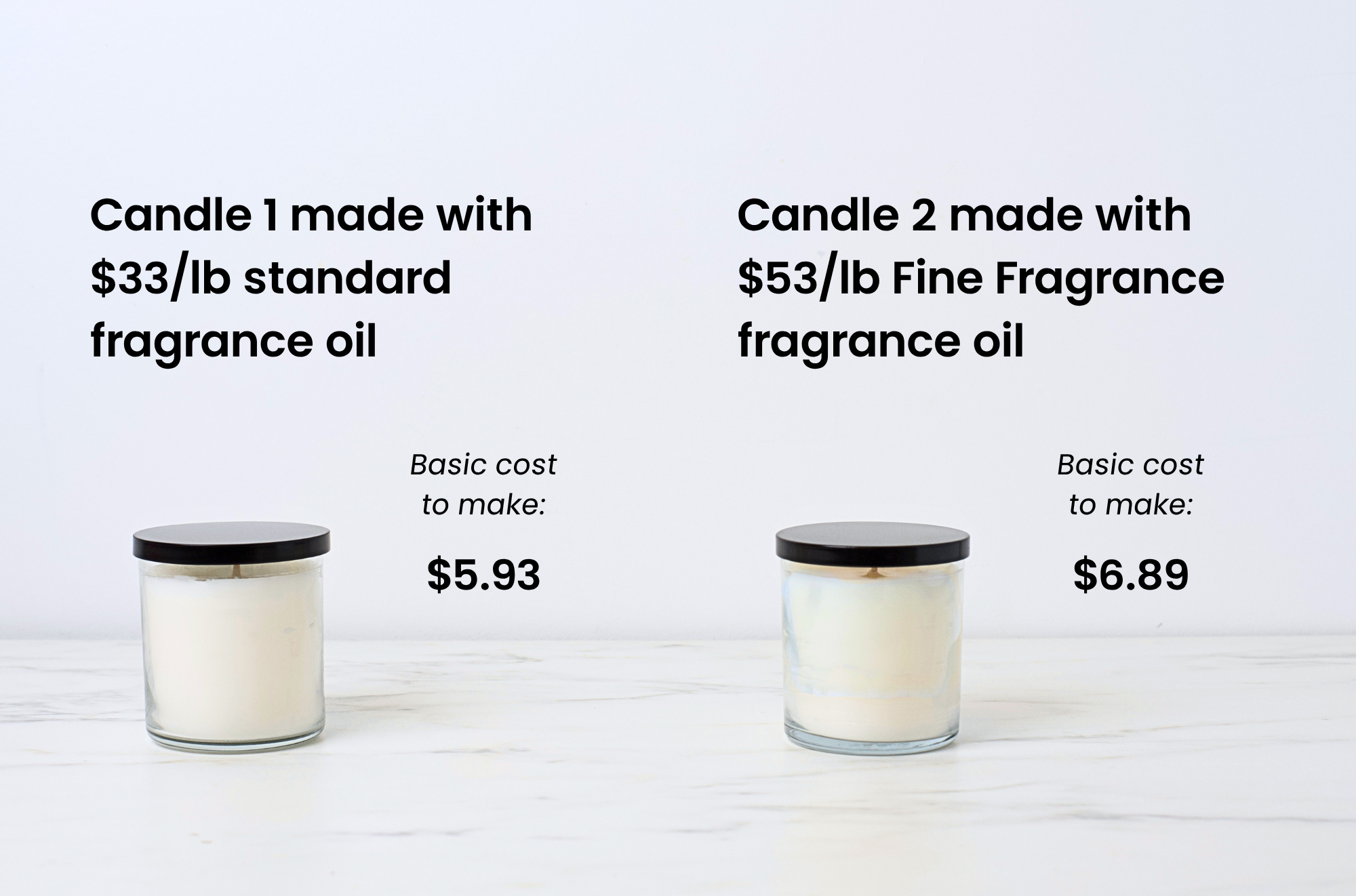
The COGs difference is only about $1 between the candles. The basic profit margins and markups translate to:
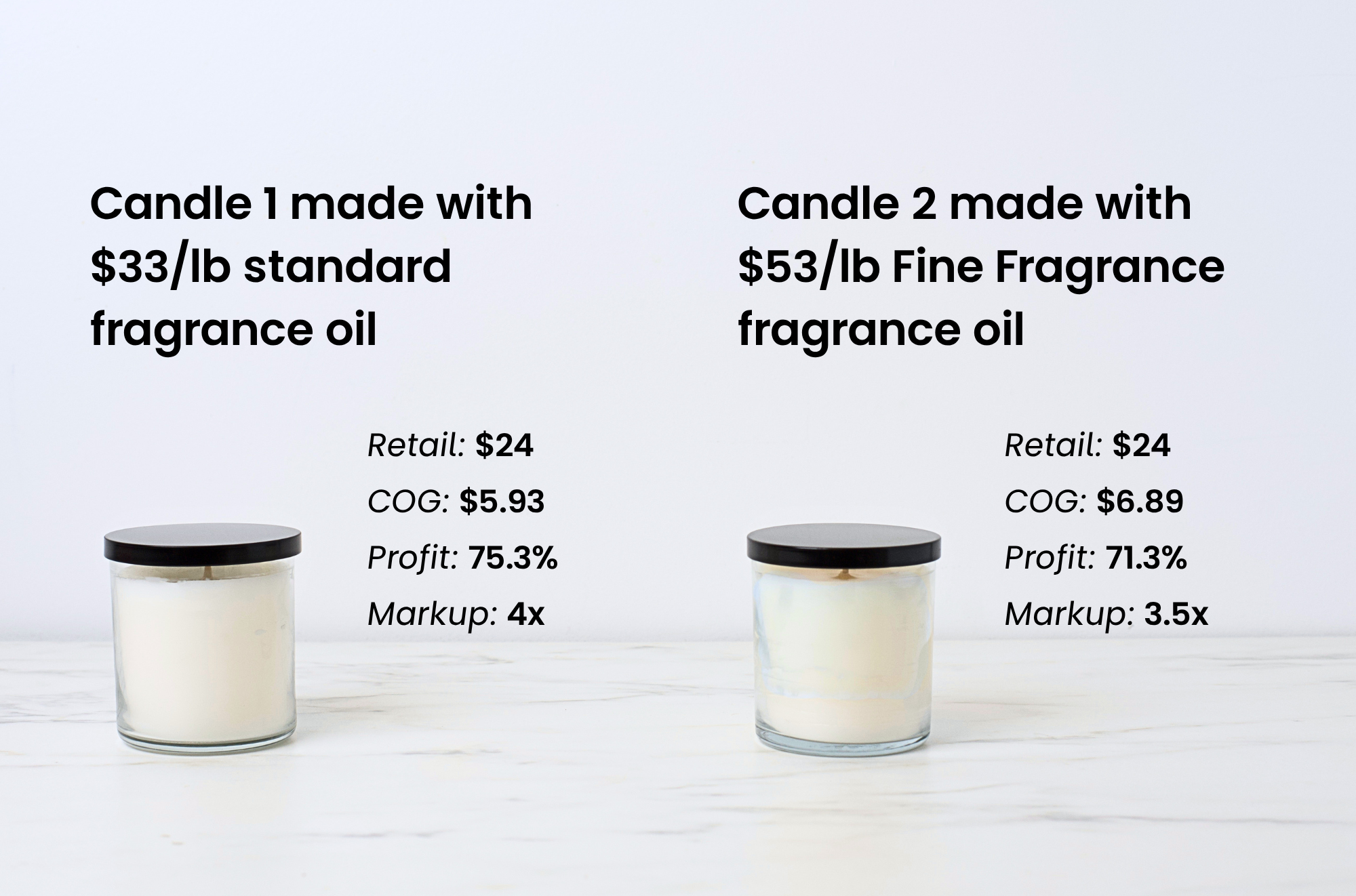
Suddenly, that $20 price difference between the 16 oz. bottles of fragrance oils shrinks to just a few percentage points in profit margin!
So, how can you strategically work these Fine Fragrance oils into your product offerings? Here are three ideas to consider.
Strategy 1: Invest in Quality Fragrances to Generate Repeat Revenue
If your business focuses on selling everyday candles, using Fine Fragrance oils in them can be an investment in customer lifetime value, which is the total revenue a single customer spends over time.
The hardest and most expensive part of business is acquiring new customers. Whether you’re paying for booth fees, social media ads, or wholesale commissions, getting someone to make their first purchase takes effort and resources. But once they buy, a product’s quality and especially its scent are often what determine if they come back.
Fine Fragrance oils address both parts of this sales cycle:
- Acquisition: These oils feature top notes designed to grab attention immediately. The moment a shopper takes the lid off a candle at a market or reads about the intriguing olfactive composition online, they’re drawn in and more likely to buy.
- Retention: Because Fine Fragrance oils are complex, they offer a burn experience that’s distinctly luxurious and rich, making customers less likely to swap your brand for mass-market alternatives.
Using the example above, accepting a $1 increase in the COGs of a $24 candle can actually be a smart trade-off when it turns one-time buyers into loyal customers for years.
Strategy 2: Create a New Collection
If maintaining maximum margins on your candles is essential to your wholesale or retail strategy, you don’t have to absorb slightly higher fragrance oil costs into your core candles. Instead, Fine Fragrance oils are ideal candidates for a separate collection within your overall product line.
These perfume-grade scent profiles give you a justifiable reason to introduce higher-price-point products in a “reserve” line or collection. And consumers naturally connect complex, perfume-like scents with luxe experiences that come with a premium price tag.
Paired with upscale containers like the heavyweight Sonoma Tumbler Jars or sleek Modern Ceramic Tumbler Jars, plus labeling and exterior packaging to match, you can design candles around these fragrances that fetch $45-$55+ retail.
Even with more expensive jars and larger amounts of wax and fragrance needed to make these candles, profit margins are higher than the Studio Jar candle examples above. And importantly, you net significantly more cash profit per candle.
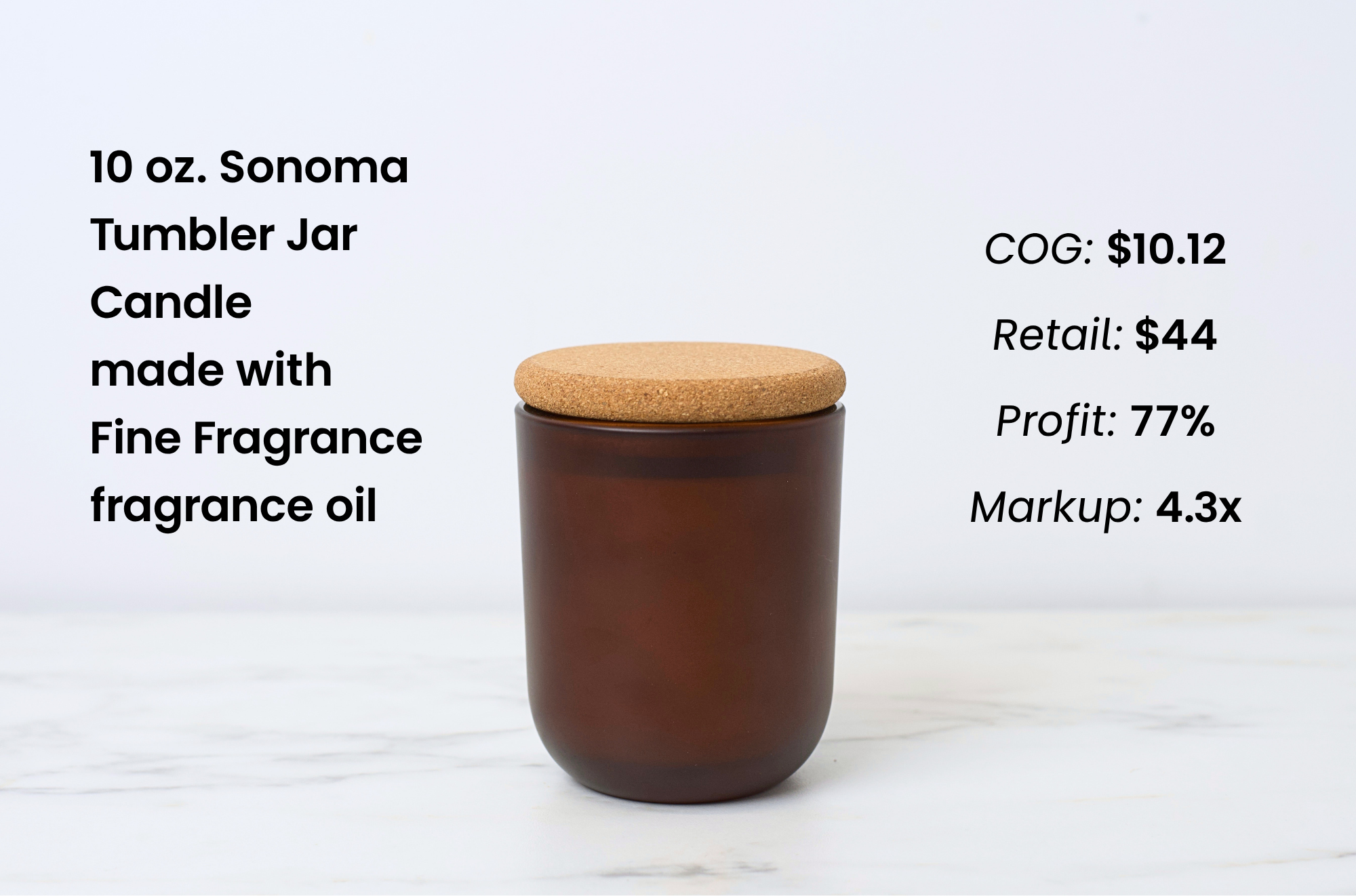
Cost & Profit Example: 10 oz Sonoma Tumbler Jar Candle
Let's say you want to design a luxury line using the Sonoma Tumbler Jars. This example shows the basic COGs to produce a candle in this container using Fine Fragrance fragrance oils—and the basic profit at a $44 retail price.
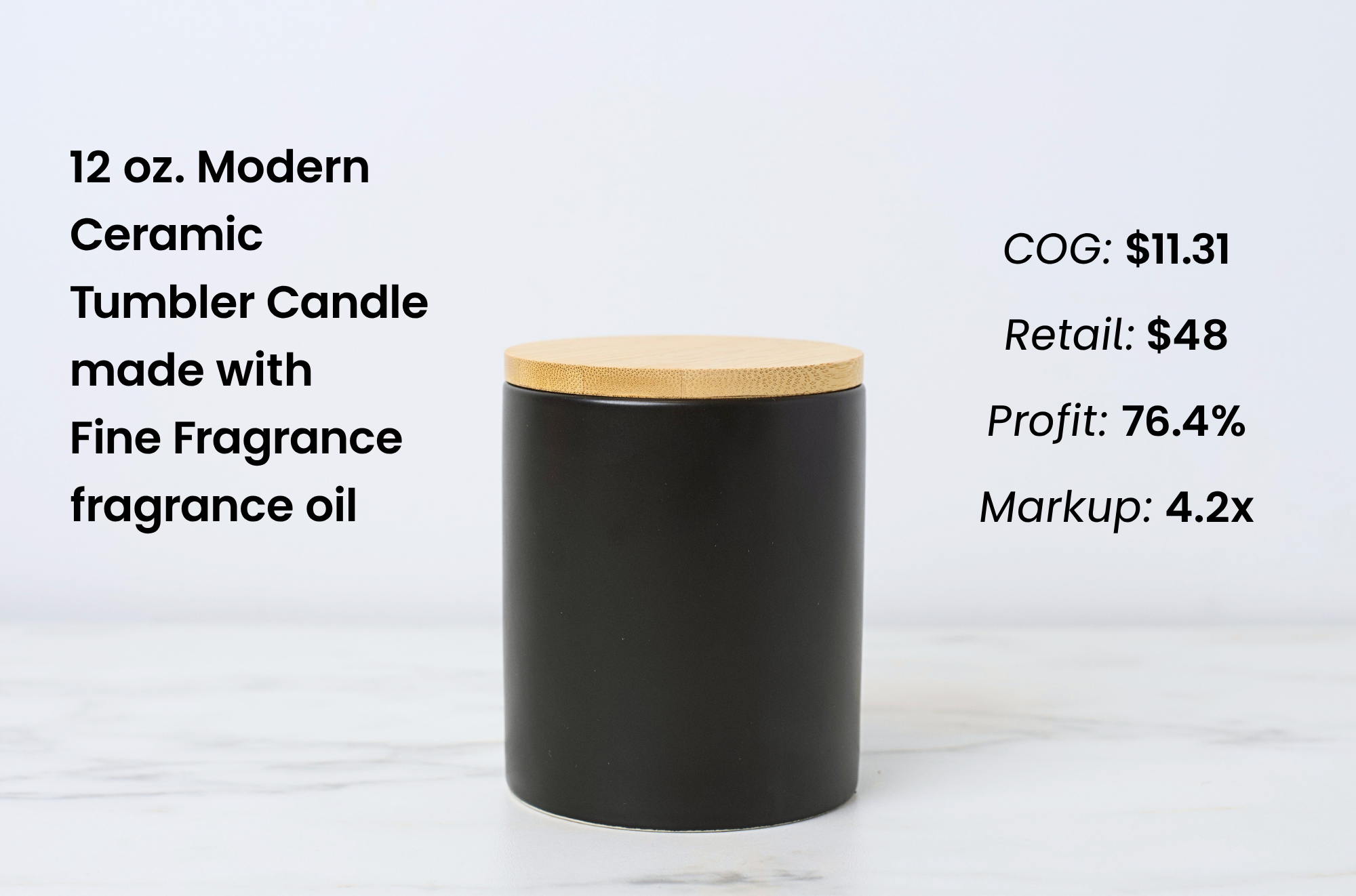
Cost & Profit Example: 12 oz Modern Ceramic Jar Candle
Another fantastic candle container for higher-end lines is the Modern Ceramic Tumbler. This example shows the basic COGs to produce a candle in this container using Fine Fragrance fragrance oils—and the basic profit at a $48 retail price.
Strategy 3: Expand into Personal Care and Wearable Fragrance
If you are interested in expanding beyond candles, Fine Fragrance oils are an exciting pathway into personal care products. They’re skin-safe and compatible with CandleScience EcoBaseTM bases—as well as our Aloe and Shea Lotion Base and 3-in-1 Bubble Bath Base.
Plus, evolving your business into wearable fragrance products increases your profit potential because consumers generally spend more on items meant for skin, hair, and body.
The High Perceived Value and Profitability of Perfumes
Eau de toilettes (EDTs), eau de parfums (EDPs), and perfume oils require more fragrance than candles, which drives up production costs. Despite this, they're among the most profitable products you can make and sell.
Consumers see fine fragrances as luxury items, so they're willing to pay higher retail prices. Shoppers routinely spend $40–$150+ on mass-produced and indie-created perfumes alike.
Cost & Profit Example: Eau de Toilette Perfume
To illustrate, let’s look at the basic cost breakdown of a 4.2 oz/120 ml EDT with a 15% fragrance load.
Since perfumes command a wide range of prices, this EDT could sell at different price points depending on how it's branded and marketed—which would then determine potential profit margins and markups.
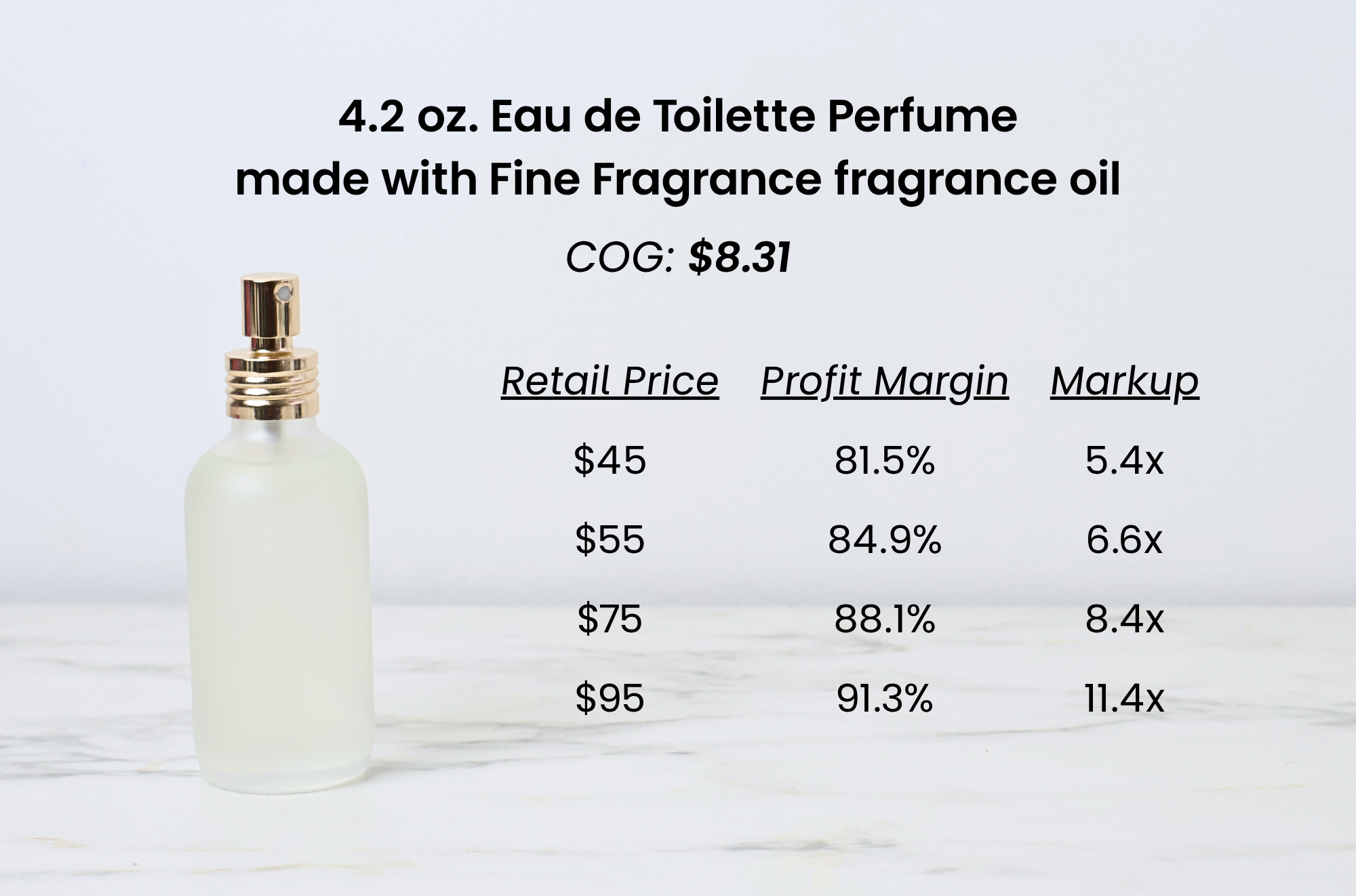
Across all example EDT price points, profits and markups are noticeably higher than in the candle examples above!
These robust figures not only help your business thrive, but also give you a cushion to absorb additional costs like sales and bulk discounts, damaged products or product losses, seasonal shipping rate surcharges, and unexpected overhead expenses.
This example EDT is a generous product size. Mass-market and designer perfumes usually sell in 1.7 oz and 3.4 oz sizes. Offering a non-standard product size can work to your advantage because it’s a point of differentiation—and in this case, it creates a perception of greater value for shoppers.
Accessible Everyday Luxuries with Lower Fragrance Loads
If perfumes aren’t financially ideal for your customer base, consider offering more accessibly priced products like lotions, body washes, liquid hand soap, bubble bath, and body mists.
They typically retail for $10-$30 depending on size. And they use the following fragrance loads that are much lower than candles and perfumes:
- Lotion: 0.5%-1%
- Body Wash/Bubble Bath/Liquid Hand Soap: 0.5%-1%
- Body and Hair Mists: 3%-5%
Since fragrance oils constitute such a small part of their COGs, the cost difference between creating them with standard versus fine fragrance oils drops to mere pennies in some cases.
And even if your customers aren’t price sensitive, you can still add these products to your line to create a wider range of product types and price points.
Etsy's marketplace algorithm favors a larger product mix for retail shoppers, and Faire is the same for wholesale buyers—which can help your products and brand appear higher in search results.
Plus, having more product types and options lets you curate bundles and gift sets, creating variety that shoppers often enjoy.
Offering a range of price points is generally a wise business strategy. Pricing variety means nearly every shopper finds at least one item within their budget—whether browsing online, in a retail store, or when discovering your products at a market.
The Multi-Application Versatility of Fine Fragrance Oils
One final benefit of the Fine Fragrance oils is their versatility. Because they work seamlessly in home fragrance and personal care bases, a single bottle lets you make candles, room sprays, reed diffusers, and body and bath products.
And this helps your business in two vital ways:
- Reducing Supply Costs: Buying single-use fragrance oils for separate products or collections often leaves you with partially empty bottles sitting on shelves—tying up cash flow in unused supplies. Fine Fragrance oils give you more ways to use a given scent across multiple products, so you don’t waste supplies or money.
- Leaner Studio Inventory: Choosing multi-use fragrance oils also means stocking fewer individual bottles or jugs. This simplifies inventory management and reordering, and keeps your workspace organized.
Because Fine Fragrance oils perform across several home fragrance and personal care bases, one bottle of fragrance allows you to create an entire product assortment!
- Home Fragrance: Mini/travel candles, wax melts, pillar and molded candles, container candles, wax sachets, reed diffusers, and room sprays
- Body Care: Cold process soap, melt and pour soap, liquid hand soap, body wash, bubble bath, lotion, body and hair mists, cologne, perfume (EDT and EDP), and perfume oils
When customers fall in love with a particular scent, they often want to experience it in many ways. With the flexibility of these fragrances, you can not only make a wide variety of products, but you can also bundle those items together into highly shoppable—and giftable—sets.
For example, curating a set with a candle, lotion, and body mist lets you easily raise your average order value, include higher-margin products, and maximize the revenue you can generate from fragrance purchases.
Final Thoughts
Building a product line is an ever-evolving process, and there’s no single “right way” to structure your offerings. Every business has unique goals, target customers, and profit thresholds. If Fine Fragrance oils don’t align with your business, our extensive library of fragrance oils still offers plenty of options.
However, if you’re looking for ways to boost customer retention, explore higher-margin products, and branch into personal fragrances, the Fine Fragrance Collection is an exciting way to elevate your business!
Have questions about formulating with Fine Fragrance oils or choosing the right EcoBase™ for your project? Drop your questions in the comments below or reach out to our support team—we’re always here to help you grow!
Also check out the Maker Business Hub for more guides, calculators, and product tutorials to help you build a thriving handmade brand.